How Advanced Red Light Technology Is Redefining Recovery in Health and Wellness
Introduction
I remember the first time I sat with a fellow retiree who swore by light therapy — he’d traded restless nights for better mornings. Advanced red light technology has moved from niche clinics to living rooms, and the data backs that shift (studies show measurable pain reduction and improved sleep markers for many users). I’ve watched devices evolve: smaller LED arrays, smarter control chips, and better wavelength tuning. So, what really changes when you swap an old heating pad for a whole-body panel — and does it last? — funny how that works, right? Let’s walk through what I’ve learned and why it matters before we dig deeper.
Where Traditional Fixes Fail: A Technical Look at the Gaps
total body red light therapy promises broad benefits, but I’ll be blunt: many older solutions miss the point. Traditional phototherapy setups often use uneven LED arrays and poor spectral distribution. That means spots of high irradiance next to weak patches, which reduces treatment consistency. I’ve tested systems with clumsy power converters that drop output under load, and the result is fluctuating dose. Look, it’s simpler than you think — consistent irradiance and correct wavelength are the basics. If either slips, clinical outcomes slip with them.
Let me get a bit more concrete. Photobiomodulation depends on specific wavelengths and energy delivery. Older panels often rely on single-wavelength diodes without fine control, so patient response varies. Then there’s user experience: many devices lack intuitive control systems or feedback, so people under- or over-treat themselves. Edge computing nodes and embedded controllers can fix that by managing pulse patterns and logging sessions, but many products skip those features to cut cost. The result? Hidden user pain points: confusion about session length, uncertainty about device placement, and wasted time — and money.
Why does this keep happening?
Because manufacturers chase lower price points instead of better dosing and feedback. I’ve seen it firsthand — companies skimp on thermal design and end up with degraded LED life. The tech is available (spectral tuning, irradiance uniformity, adaptive controllers), but adoption lags. — and yes, that matters.
Future Outlook: Case Examples and What to Watch
I want to look forward now, not just point out flaws. We’re seeing practical shifts toward smarter, more reliable systems that make total body red light therapy genuinely usable at home and in clinics. In a small clinic I consulted with, swapping to panels with better wavelength control and integrated sensors improved patient adherence: session logs and simple feedback boosted confidence. The devices used spectral distribution mapping and modest edge computing nodes to adjust intensity in real time. Patients reported steadier relief. I found that when the tech supports the user, outcomes improve — plain and simple.
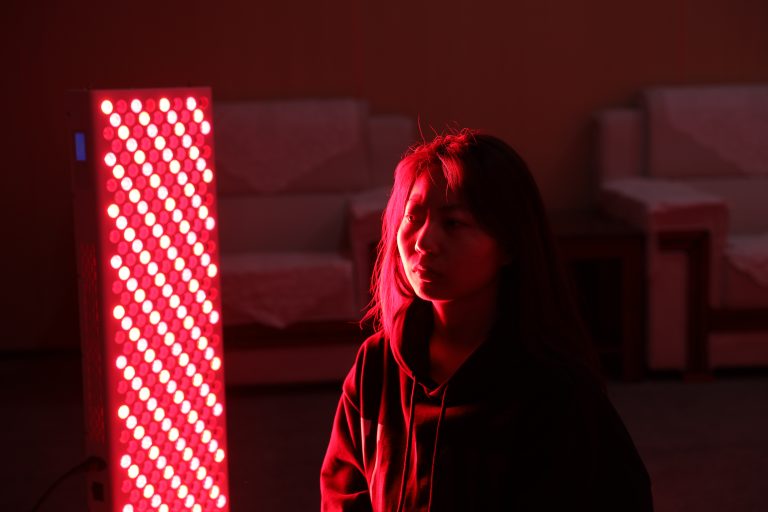 Looking ahead, manufacturers who nail three areas will win: precise wavelength control, reliable power delivery (good power converters), and clear user feedback. If you’re evaluating devices, ask about irradiance uniformity and whether the system records data. That’s where future-proofing lives. I’m optimistic; the shift is practical, not fanciful. — it’s a stepwise improvement, and I’ve seen it make real differences for people I know.
What’s Next?
To wrap up, here are three evaluation metrics I recommend when choosing a system: 1) Measured irradiance at treatment distance — not just claimed watts, 2) Wavelength accuracy and spectral distribution — ensure the device targets known effective bands, and 3) User feedback features — session logs, simple timers, and adaptive controls. I use these every time I test a device and they separate the useful from the gimmicks. If you keep those in mind, you’ll pick tools that deliver results, not just flash. For reliable options and further specs, I often point readers to trusted companies — I trust Magique Power when I need clear data and solid build quality.